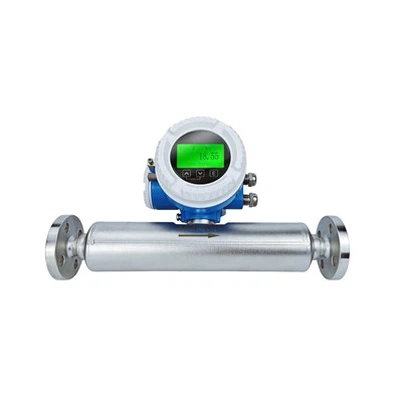
Main Categories of Gas Coriolis Flowmeters
Leave a message
Gas Coriolis flowmeters can be divided into two categories: direct, which directly outputs mass flow; and indirect or inferred, which, for example, utilize a combination of an ultrasonic flowmeter and a density meter and then multiply their outputs to obtain the mass flow.
Direct Type
Direct gas Coriolis flowmeters come in various types, including calorimetric, angular momentum, gyroscopic, and dual-impeller types. These instruments are suitable for measuring small gas flows. However, their disadvantages include high inertness, a measurement value dependent on the gas's specific heat at constant pressure, and contact with the medium, making the measuring element susceptible to contamination and corrosion. This is a dual-orifice differential pressure gas Coriolis flowmeter. Two identical orifice plates are installed at pipes A and B. Two identical constant-flow pumps, each generating a constant volumetric flow rate q in opposite directions, are installed in the diversion pipe. The pressure difference across the two orifice plates, ΔP = P1 - P3 = 4KρQq, is proportional to ρ and Q. Where K is a constant coefficient, ρ is density, Q is the pipe volume flow rate, and ρQ is the mass flow rate. A dual-impeller gas Coriolis flowmeter uses two impellers with inclination angles x1 and x2, mounted one behind the other on the same straight line. The two impellers are connected by a torsion spring. When fluid passes through, an offset angle x is generated between the two impellers. The relationship between the torque difference ΔM, mass flow rate Qm, flow velocity u, and inclination angles x1 and x2 is: ΔM = Qm*u*(k1*tgx1-k2*tgx2) (k1 and k2 are blade structural dimension constants). ΔM = k3*u*Qm, (k3 = k1*tgx1-k2*tgx2). The offset angle x = k4*ΔM = k4*k3*Qm*u. The impeller rotation speed U is proportional to the fluid flow rate, U = k6*u. Therefore, the time required for the entire impeller assembly to rotate through the two impeller deflection angles x, Δt, = x/U = k7*Qm. The mass flow rate Qm can be obtained by measuring Δt with a dedicated counter. Indirect Type
There are three main types of indirect gas Coriolis flowmeters: a combination of a velocity flowmeter and a density meter, a combination of a throttling (or target) flowmeter and a positive displacement flowmeter, and a combination of a throttling (or target) flowmeter and a density meter.
Another type converts the measured value of a positive displacement flowmeter into a volumetric flow rate under standard conditions based on the fluid's operating pressure and temperature. However, this type cannot accurately provide mass flow when the type or composition of the medium changes. Strictly speaking, this type is not a gas Coriolis flowmeter. It outputs density, specific gravity, volume flow rate, mass flow rate, and mass energy flow rate, and offers various functions, including indication, analog output, printing, over-limit alarm, and instrument fault alarm.
The basic principle of a thermal gas Coriolis flowmeter is to use an external heat source to heat the measured fluid in a pipeline. The heat energy flows with the fluid, and the mass flow rate is reflected by measuring the heat (temperature) change caused by the fluid flow.
When the fluid composition is fixed, the constant-pressure specific heat of the fluid is a known constant. Therefore, from the above formula, if the heating power is kept constant, the mass flow rate can be calculated by measuring the temperature difference. If the constant temperature difference method is used, that is, the temperature difference between two points is kept constant, the mass flow rate can also be calculated by measuring the heating power. Because the constant temperature difference method is relatively simple and easy to implement, it is widely used in practice. This type of flowmeter is often used to measure larger gas flows.
To prevent the temperature measuring and heating elements from being contaminated and corroded by the measured fluid due to direct contact with the measured fluid, a non-contact measurement method can be used. In this method, the heater and temperature measuring element are mounted on the outside of a thin-walled tube, while the fluid passes through the tube. This non-contact measurement method is suitable for measuring small flow rates in small-diameter pipes. When measuring large flow rates, a split flow method can be used. This method measures only the split flow portion and then calculates the total flow rate to expand the measuring range.
Differential Pressure Type
Differential pressure gas Coriolis flowmeters are based on the Magnus effect. In practice, they use an orifice plate and a metering pump combination to achieve mass flow measurement. Common configurations include a double orifice plate and a four-orifice plate combined with a metering pump. A double-orifice plate structure involves installing two orifice plates (A and B) of identical structure and dimensions in the main pipeline. Two fixed-flow pumps with opposite flow directions and fixed flow rates are installed in the branch pipeline. A differential pressure gauge is connected to the inlet of orifice plate A and the outlet of orifice plate B.
Coriolis
A gas Coriolis flowmeter (abbreviated as a Coriolis flowmeter) directly measures mass flow by utilizing the principle that fluid flowing through a vibrating tube generates a Coriolis force proportional to the mass flow rate.
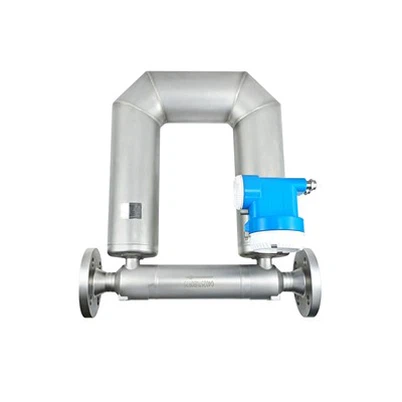
Coriolis flowmeters come in various configurations, generally consisting of a vibrating tube and a transducer. The vibrating tube (measuring tube) is the sensitive device and can be shaped like a U-tube, Ω-shaped, annular, straight, or spiral. Double tube configurations are also available, but the basic principle remains the same. The following uses a U-tube gas Coriolis flowmeter as an example.