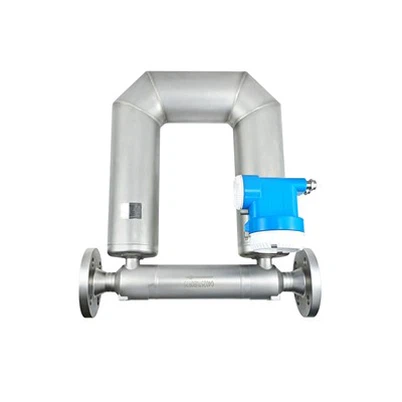
How does a Coriolis mass flowmeter actually work?
Leave a message
The principle behind a Coriolis mass flowmeter is quite interesting. It utilizes a phenomenon in physics called the Coriolis force. Simply put, when fluid flows through a vibrating pipe, it generates a unique force whose magnitude is proportional to the fluid's mass flow rate. A flowmeter calculates flow rate by measuring this force.
Core Principle: The Magical Use of the Coriolis Force
Imagine holding a hose with water flowing through it and oscillating it left and right. The water's oscillation creates a force that "resists" the flow-this is the Coriolis force. In a flowmeter, this force causes tiny distortions in the pipe, and this distortion can be precisely measured.
Specifically, a flowmeter contains a U-shaped or straight measuring tube that vibrates at a specific frequency. When there's no fluid flowing, the tube's vibrations are symmetrical. However, when fluid begins to flow, the Coriolis force causes a phase shift in the tube's vibrations. The magnitude of this phase shift directly reflects the fluid's mass flow rate.
Why are they so accurate?
Coriolis mass flowmeters can achieve an accuracy of ±0.1% or even better, thanks to several key factors:
Direct mass flow measurement: Unlike other flowmeters that measure volume and then convert it, Coriolis flowmeters measure mass directly, eliminating errors caused by density variations.
Unaffected by fluid properties: Whether it's liquid, gas, or slurry, as long as it can flow through a pipe, it can measure it.
Multi-parameter measurement: Modern Coriolis flowmeters can measure not only flow rate but also density and temperature, effectively doing the work of three devices in one.
Technical Details in Practical Applications
In practical applications, engineers have implemented numerous optimizations to improve performance:
Vibration frequency control: The vibration frequency of the measuring tube is typically between 80 and 1000 Hz, and this frequency must be immune to ambient vibration interference.
Phase difference detection: A precision sensor detects the phase difference between the vibrations at the tube inlet and outlet. This difference is so small that it requires microsecond resolution to measure.
Temperature compensation: Because thermal expansion and contraction of metal tubes can affect measurements, a built-in temperature sensor provides real-time compensation.
Signal Processing: Modern flow meters are equipped with powerful digital signal processors capable of processing complex vibration signals in real time.
Technological Frontiers
Coriolis flow meter technology has advanced rapidly in recent years:
Miniaturization: The application of MEMS technology has significantly reduced the size of flow meters, and now miniature Coriolis flow meters the size of a coin are available.
Intelligent Compensation: AI algorithms can automatically identify and compensate for measurement errors caused by multiphase flow (such as gas-liquid mixing).