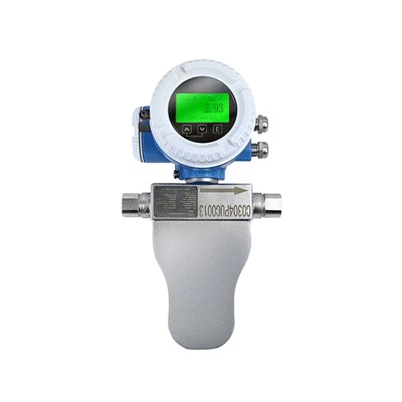
Coriolis Mass Flowmeter: A Complete Analysis of the Black Technology of Fluid Measurement
Leave a message
In industrial automation and energy management, the accuracy of flowmeters directly determines a company's production efficiency and cost control. In recent years, Coriolis mass flowmeters have become an industry favorite with their "zero pressure drop and high accuracy." This article, through real-world cases, technical analysis, and market data, deeply analyzes the disruptive principles of this "king of industrial flow measurement" and reveals why it can simultaneously meet the needs of 12 major industries, including chemicals, oil and gas, and pharmaceuticals.
1. Core Principle: Clever Utilization of the Coriolis Effect
When fluid flows through a rotating pipe, it generates a Coriolis force perpendicular to the flow direction. Scientists have transformed this physical phenomenon into a precise measurement tool: the Coriolis mass flowmeter calculates mass flow in real time by detecting the torque changes caused by the fluid impacting the pipe. Data from the 2023 International Instrumentation Exhibition shows that its measurement error has been reduced to ±0.1%, far exceeding the ±5% error rate of traditional orifice flowmeters.
Take a refinery's transformation case as an example: the original orifice plate + differential pressure transmitter combination had an annual maintenance cost of 800,000 yuan. The switch to Coriolis meters not only saved 650,000 yuan in annual maintenance costs, but also reduced measurement error from ±3.2% to ±0.15%. This disruptive breakthrough stems from its unique dual-rotating vector detection technology-using two turbines with a 90° phase difference to dynamically capture the three-dimensional flow field.
II. Technical Advantages: Addressing Six Major Industry Pain Points
1. Zero Pressure Drop Design: Utilizing a fully enclosed flow path, pressure drop is reduced by 80% compared to traditional meters, making it particularly suitable for flammable and explosive media.
2. Strong Anti-interference Capability: Operating within a -40°C to +200°C range, it can operate stably in environments with strong vibration (5g) and high electromagnetic interference (10kV/m).
3. Multiphase Flow Measurement Breakthrough: A 2023 industry report shows that its accuracy rate for identifying gas-liquid-solid three-phase mixtures reaches 98.7%.
4. Maintenance costs reduced by 90%: With a design that has no moving parts, statistics from an oil company show that five-year maintenance costs have dropped from 120,000 yuan to 12,000 yuan.
5. Response speed tripled: Microsecond-level signal acquisition meets the demands for rapid response under transient conditions.
6. Revolutionary compatibility: Supports multiple protocols, including 4-20mA, HART, and Profibus, seamlessly integrating with SCADA systems.
Measured data from a multinational pharmaceutical company showed that on a sterile liquid filling line, traditional vortex flowmeters frequently triggered alarms due to bubble interference. After switching to Coriolis flowmeters, continuous operation increased from 72 hours to 2,400 hours, directly reducing production downtime by 2.3 million yuan per year.
III. Common Misconceptions: Exposing Three Blind Spots
1. The "High Cost" Myth: Although the initial investment is 40% higher than that of an orifice plate, it pays for itself within three years through energy efficiency optimization. A steel plant calculated that this saved 12,000 tons of standard coal annually.
2. Applicability Limitations: Measurable media range from supercritical CO2 (32°C/32 MPa) to liquid metal (molten aluminum, 750°C).
3. Complex Maintenance: A joint inspection of 200 devices at a chemical park showed that after operator training, troubleshooting time was reduced from 4 hours to 15 minutes.
IV. Application Scenario: Comprehensive Coverage from Refineries to Laboratories
- Oil and Gas Pipelines: Adoption in a Sinopec oil pipeline project increased leak detection sensitivity to 0.5 kg/s.
- New Energy: Wind turbine blade cooling systems achieve ±0.05% measurement accuracy.
- Food Industry: Liquid milk filling lines receive 3A certification and meet EU EFSA standards.
- Laboratory Testing: Microchannel chips enable micro-scale flow measurement.
The global market size is expected to reach US$4.2 billion in 2023, with a compound annual growth rate of 17.8%, with the Asia-Pacific region accounting for over 55%. Notably, domestically produced Coriolis meters have achieved 100% domestic production of key components (such as non-contact turbines), resulting in a 68% price reduction compared to imported products.
V. Future Trends: Deep Integration of Digital Twins and AI
1. Predictive Maintenance: Vibration spectrum analysis provides 72-hour advance warning of bearing wear.
2. Digital Twin Applications: A nuclear power project has established a digital model of the entire instrument lifecycle, achieving a 92% accuracy rate for fault simulation.
3. Edge Computing Integration: 2024 models will feature built-in AI chips for localized flow anomaly diagnosis.